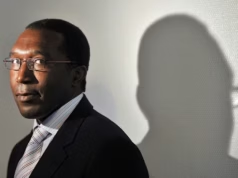

The Paris Court of Assize has upheld the 27-year prison sentence imposed on Dr. Eugène Rwamucyo for his role in the 1994 Genocide against the Tutsi, while slightly modifying the legal findings made by the trial court. The appeal judgment, delivered on 17 July 2026 after more than a month of hearings, confirmed that Rwamucyo bears criminal responsibility for three offences linked to the genocide and crimes against humanity.
The appeal proceedings followed Rwamucyo’s conviction by the Paris Court of Assize in October 2024, where he had been sentenced to 27 years’ imprisonment. In the first-instance judgment, the court found him guilty of four offences: complicity in genocide, participation in a conspiracy to prepare genocide, complicity in crimes against humanity, and participation in a conspiracy to prepare crimes against humanity. At the same time, he was acquitted of the principal charges of genocide and crimes against humanity. Rwamucyo appealed the decision, arguing that he had been wrongly convicted.
After reviewing the evidence presented during the appeal trial, the court maintained the 27-year prison sentence but reduced the number of convictions from four to three. The judges convicted him of participation in a conspiracy to commit genocide and crimes against humanity, complicity in genocide, and complicity in crimes against humanity. The separate conviction relating to participation in a conspiracy to prepare crimes against humanity was no longer retained as an independent offence in the final judgment.
According to the appeal court, Rwamucyo participated in a criminal agreement to commit genocide and crimes against humanity in the former Butare Prefecture between April and July 1994. The court also found him guilty of complicity in atrocities committed in the communes of Ngoma, Gishamvu, Ndora and Huye, where thousands of Tutsi civilians were targeted during the genocide.
Dr. Rwamucyo, a former public health official in Butare who later settled in France, had consistently denied all allegations throughout both trials. However, the appeal court concluded that the evidence was sufficient to uphold his criminal responsibility despite modifying part of the legal characterization of the offences.
The ruling marks another significant step in France’s efforts to prosecute suspects accused of participating in the 1994 Genocide against the Tutsi under the principle of universal jurisdiction. With the appeal court confirming the prison sentence, the judgment reinforces France’s commitment to holding genocide suspects accountable decades after the atrocities occurred.