Karongi leaders vow to sustain livestock gains as PRISM project ends

Authorities in Karongi District said that gains made under a partner-supported livestock programme will be sustained after the project ends later this year, citing improved farmer capacity, market access and local ownership.
The Partnership for Resilient and Inclusive Small Livestock Markets (PRISM) project has supported vulnerable households and youth groups with goat, pigs and poultry in five low agricultural production sectors Gashari, Murambi, Murundi, Mutuntu and Ruganda, since November 2021.
Umuhoza Pascasie, Karongi’s Vice Mayor in charge of Social Affairs, said the district was confident that progress would continue beyond the project’s lifecycle.
“Although the project is nearing its end, we are confident that the achievements it has delivered will continue to grow. There are concerns that some initiatives may collapse once partner support ends, but we are 100 percent confident this will not be the case, given the progress communities have already made,” she said.

According to district figures, PRISM distributed 4,576 animals through an initial placement scheme. Through the Passing on the Gift approach where beneficiaries pass on livestock offspring to other households an additional 5,528 animals have been shared, bringing the total number of animals distributed to 10,104 across Karongi District.
Before receiving livestock, beneficiaries underwent training in saving practices, nutrition and modern livestock management, while the animals have also contributed to improved access to organic manure, boosting soil fertility and crop productivity in the targeted sectors.
The PRISM project is a joint initiative implemented by the Rwanda Agriculture and Animal Resources Development Board (RAB) and funded by the International Fund for Agricultural Development (IFAD). Its main objective is to reduce rural poverty by empowering poor men, women and youth through improved access to small livestock markets.
One beneficiary, Murekatete Odette, said the project had transformed her life. Once classified among the poorest households, she is now a poultry trader after receiving chickens through the programme.
“I was extremely poor when I received 10 chickens. After passing some on to others, I continued raising the remaining ones and started selling them. Today I can support myself and even have a place to live,” she said.
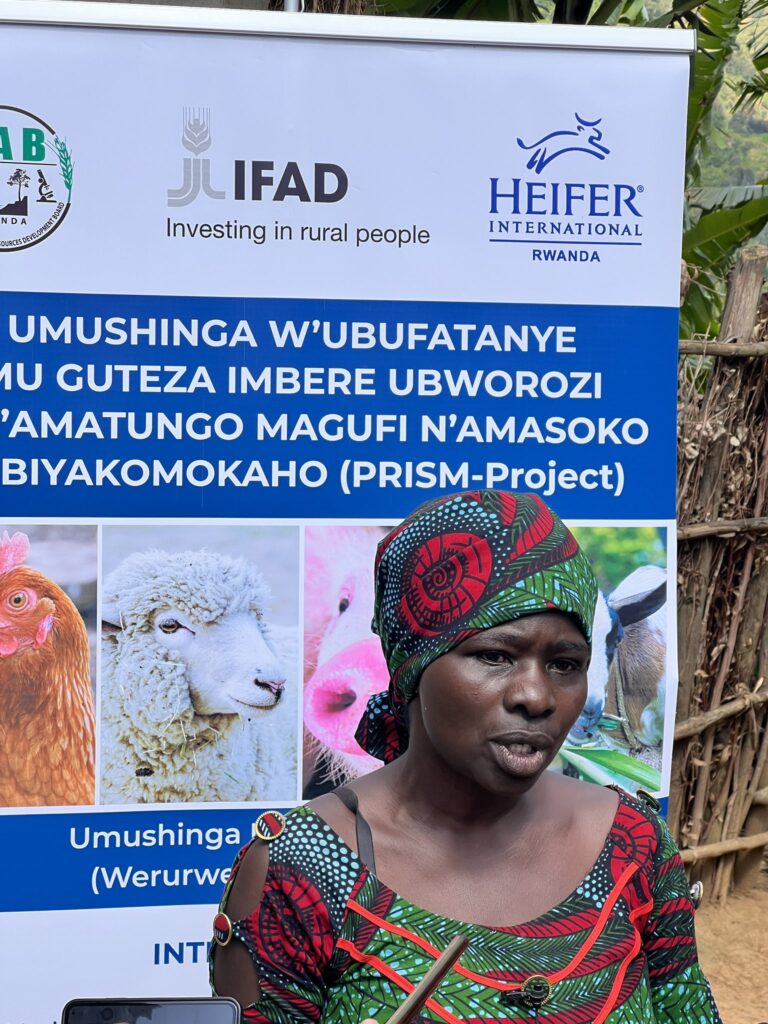
Murekatete currently owns more than 160 chickens, although she recently lost about 100 birds to disease. She cited the high cost and long distance to access animal feed as her main challenge.
Karongi’s Vice Mayor, Umuhoza, said the issue of animal feed prices was well known and had been raised at national level.
“The challenge of expensive animal feed is known, and even senators have been briefed on it. We are waiting for advocacy efforts that could result in subsidies,” she said.
Beyond household-level support, PRISM has also delivered broader economic benefits by constructing Karongi’s first livestock market and a pig slaughterhouse, infrastructure that previously did not exist in the district.
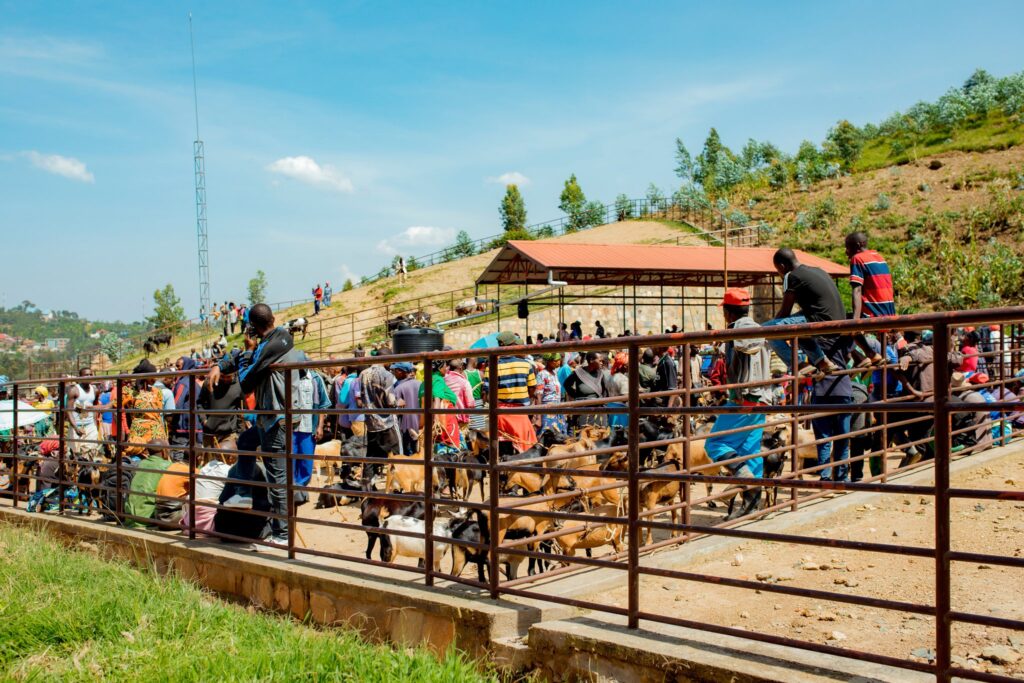
Nyirabantu Mariya, a livestock trader from Rubagwe Cell in Rubengera Sector, said the new market had transformed the way livestock trade is conducted.
“Before, livestock trading was informal and difficult. Transactions were often done secretly, sometimes along the roadside without basic facilities like toilets. Now we bring animals to the market, sell them transparently and pay taxes,” she said.
She added that traders spend long hours at the market and appealed for additional services.
“We ask that a small restaurant be built here so traders can at least buy water or food without having to leave the market,” she said.
Other residents have also benefited from the project through the provision of 126 water storage tanks and solar energy systems in sectors not connected to the national electricity grid.