
By Rachid Bugirimfura
Dr. Violette Ayingeneye was on the verge of pursuing medical specialization when life took an unexpected turn. After 12 years in medicine, she was offered a hospital leadership position, an opportunity that would derail her clinical studies forever.
“Just as I was about to continue my specialization, I was given the responsibility of leading a hospital, which stopped me from continuing my clinical studies,” she recalls. “I chose to study public health instead. I believe many other women face similar circumstances.”
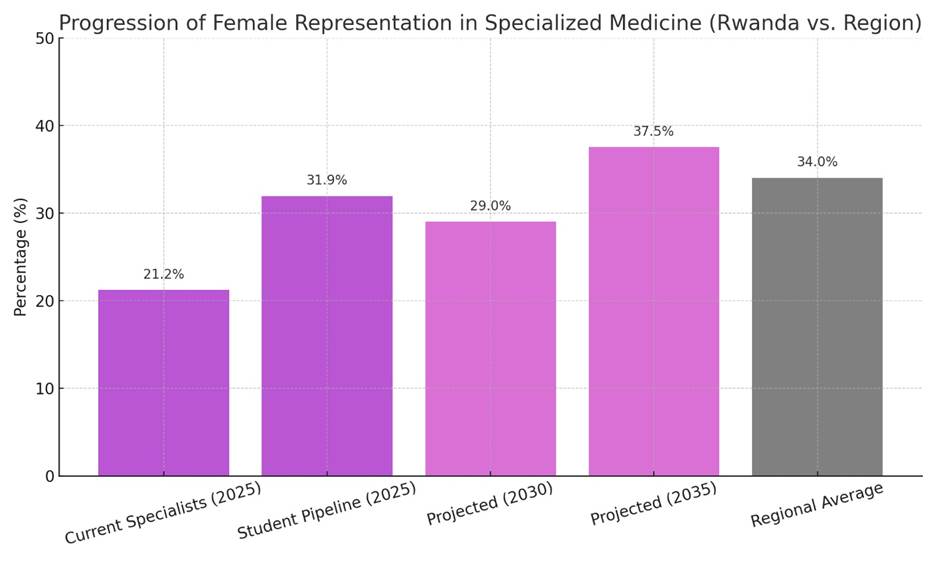
Her story illustrates a broader challenge facing Rwanda’s healthcare system. Despite the country’s reputation for advancing gender equality, new data from the Rwanda Medical and Dental Council reveals a stark reality: of the 848 licensed specialized doctors in Rwanda, only 180 are women, just over 21%, according to RMDC data received on June 11, 2024.
This underrepresentation exposes a critical paradox. While Rwanda successfully encourages girls to pursue STEM education, it struggles to retain women through the demanding journey of medical specialization, a gap that threatens to undermine the nation’s ambitious health targets.
A Stark Professional Landscape
The statistics paint a troubling picture across medical specialties. Marie Grace Kansayisa, an orthopedic surgeon practicing at Legacy Clinics and Kigali University Teaching Hospital, has documented this disparity in her research, finding “an average of one female surgical trainee per 18 males” in Rwanda’s surgical programs.
In neurosurgery, the imbalance reaches its most extreme. Dr. Claire Karekezi, one of Rwanda’s pioneering neurosurgeons, established her practice at Rwanda Military Hospital in January 2022, spending months creating a functional neurosurgical unit from scratch. Her journey illustrates both the pioneering spirit required and the structural challenges facing women in highly specialized fields. The neurosurgery specialty in Rwanda is relatively young, with formal neurosurgical units only established in recent years, making the presence of only two female graduates since inception particularly significant.
Yet there are encouraging signs. At the University of Rwanda, female enrollment in specialized medicine is rising significantly. In 2021/2022, 44 women were registered among 180 students (24.4%). By April 2025, this had jumped to 104 women among 326 registered students (31.9%).
The broader question remains: are these numbers sufficient for Rwanda’s healthcare needs? With 1,350 physicians total in Rwanda as of 2018, translating to 1 doctor per 8,919 population, below the national target of 1 doctor per 7,000 population by 2024, the country faces both quantity and gender balance challenges in its medical workforce.
The Transfer Trap
Dr. Violette Ayingeneye’s story illustrates how systemic barriers intersect with personal choices. With 12 years of leadership experience in hospitals, she was poised to pursue specialization when institutional demands redirected her path. “Just as I was about to continue my specialization, I was given the responsibility of leading a hospital, which stopped me from continuing my clinical studies. I chose to study public health instead. I believe many other women face similar circumstances.”
The transfer system poses another barrier. Transfer decisions for medical professionals are made jointly by the Ministry of Health and district officials, creating a coordination challenge that often prioritizes immediate staffing needs over long-term career development. Ayingeneye explains: “Being transferred every four months prevents them from having stability. If these frequent transfers stopped, and they stayed in one place, giving their children’s lives some stability while they studied, it would increase their numbers.”
Dr. Dushimimana, a final-year internal medicine trainee, acknowledges progress in institutional policies: “There are more flexible policies now, women can study while pregnant or even after giving birth, which wasn’t the case before.” The elimination of mandatory two-year work requirements before postgraduate programs has also helped, she notes.
Regional Context: A Shared Challenge
Rwanda’s challenges mirror those across East Africa. The surgical profession across East Africa faces similar gender disparities. Research from the Association of Surgeons of East, Central and Southern Africa shows that surgery as a profession experiences a general shortage of staff, which often results in longer working hours for existing specialists. Studies consistently cite “insufficient role models and insufficient institutional support” as key barriers preventing women from entering surgical specialties throughout the region.
In Kenya, gender differences in surgical access have been documented, with research showing disparities in insurance coverage and surgical outcomes that reflect broader systemic inequalities. Uganda faces similar challenges, where the overwhelming demand for medical services far exceeds the supply of trained personnel, creating additional pressure on the few women who do enter specialized practice.
The WomenLift Health program operates across East Africa, including Rwanda, Kenya, Uganda, Tanzania, South Sudan, and Ethiopia. The program offers fully-funded, 12-month leadership journeys specifically designed for mid- to senior-career women in health, providing participants with mentorship, networking opportunities, and leadership development tools. Rwandan medical specialists are eligible to participate in these programs, which aim to address both individual and systemic barriers facing women in health leadership roles.
The Professional Voices
“We don’t need sympathy. We need structures that allow women to grow without sacrificing their ambitions or their families,” emphasized Dr. Dushimimana, reflecting broader professional sentiment documented across the region.
The medical profession’s call for change extends beyond individual voices. Women surgeons across Africa have begun organizing through initiatives like Women in Surgery Africa, which focuses on creating networks and support systems for women in surgical specialties. These professional networks argue that addressing the gender gap requires both individual mentorship and systemic policy changes.
Dr. Louise Mwiseneza, who transitioned from general practice to specialize in infectious diseases, sees encouraging signs: “In the endocrinology program, there are now only three Rwandans, and all of them are women. That’s encouraging.”
The Government of Rwanda has launched an ambitious response through its 4X4 health reform program. The initiative aims to quadruple the number of healthcare workers within four years to meet the WHO recommendation of at least 4 healthcare professionals per 1,000 population.
Dr. Menelas Nkeshimana from the Ministry of Health emphasizes that gender equity is built into the program’s foundation. “The 4X4 program is gender-friendly because we hired two officials specifically to ensure the gender policy is respected in the program and to identify challenges and address them,” he explains.
In November 2023, the Ministry of Health and Ministry of Education signed a synergy Memorandum of Understanding with 31 institutions including 13 higher learning institutions, 14 teaching hospitals, and 4 professional councils to commit to work together and share knowledge and resources where needed to increase Rwanda’s health workforce. As part of this initiative, five new training programs were launched in partnership with the University of Rwanda.
Beyond the 4X4 program, the ministry projects a 3.7-fold increase in medical students, with a 40% expansion in the University of Rwanda’s intake capacity. Thirteen new medical specialties have been introduced, and over $62 million has been mobilized from partners to support health workforce development. A new Advanced Health Sciences School has been established to enhance postgraduate medical training.
Looking Ahead
Marie Grace Kansayisa’s research points toward concrete solutions: “An important strategy for increasing the number of trainees in Rwanda is by building interest and reducing barriers for women to pursue surgical careers.” She argues that “there must be concerted effort to change policies to attract and retain surgical trainees, especially in contexts such as Rwanda where a lack of medical specialists has been described.”
For Dr. Ayingeneye, the solution starts with institutional stability. If the frequent transfer system were reformed and women could maintain geographic stability while pursuing their studies, she believes the numbers would improve dramatically.
The challenge facing Rwanda is clear: the country’s remarkable success in promoting girls’ STEM education must be matched by systemic changes that support women’s advancement through the entire medical career pipeline. Only then can Rwanda achieve both its gender equality aspirations and its critical health workforce targets.
With rising numbers of women entering medical school and new policies acknowledging gender challenges, the foundation for change exists. The question now is whether Rwanda’s institutions can evolve quickly enough to retain the talent they’re successfully recruiting.