Despite considerable investments and reforms implemented over the past few years, it has become evident that the sector is not yielding results commensurate with the level of input. Many economists argue that agricultural performance is falling short of expectations, particularly due to its low productivity compared to the industrial sector, which is experiencing growth of 16 per cent.
Agriculture employs over 65 per cent of Rwanda’s total labour force and contributes 22 per cent to the country’s GDP, according to the National Institute of Statistics of Rwanda (NISR). The sector registered an eight per cent growth in the fourth quarter of 2025, contributing to an overall GDP growth of over nine per cent.
The government has made significant investments over the years in programmes such as Food Basket Sites (FOBASI) to improve agricultural practices and enhance yields.
Policy Ambition Versus Field Reality
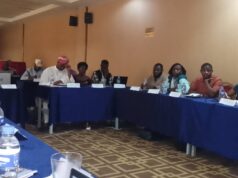
A field study conducted by the umbrella organisation of local development partners in Rwanda (CCOAIB) in Gatsibo, Nyamagabe, and Nyaruguru districts reveals that farmers frequently face delays in receiving crucial agricultural inputs such as fertilisers, improved seeds, and pesticides.
The cost of production is another concern for farmers, who argue that the government’s Smart Nkunganire agricultural subsidy programme is insufficient to shield them from inflated fertiliser prices. “There are instances where we do not have access to subsidised fertilisers, forcing us to purchase them at high market prices. This affects our input costs and, consequently, our productivity,” argues Thereza Uwamurera, a farmer in Nyaruguru district.
Challenges associated with digital reform and exclusion risks
The Smart Nkunganire system, designed for distributing subsidies, has been recognised as a reform aimed at promoting transparency in the sector. However, its implementation faces challenges, particularly for elderly rural residents and farmers without mobile phones who struggle to access the digital platform.
According to a local farmer in Gatsibo District, “many farmers find it difficult to register on the programme’s portal,” while agro dealers complain about delays in the registration process. Field specialists have also identified a lack of knowledge regarding the proper use of inputs as a significant challenge.
Josianne Manirakiza, an agronomist, notes that “the lack of effective coordination between farmers, extension workers, and local officials prevents farmers from using inputs efficiently.” Additionally, the low rates of mechanisation and the limited adoption of new technologies are noteworthy challenges.
Land policy and Equity issues
The land policy has introduced other dynamics for example, authorities in Nyamagabe District have prohibited individuals from outside the local community from cultivating the marshlands in the district.
Vice-Mayor in charge of Economic Affairs, Thaddee Habimana, argues that “marshlands should be utilised by locals who also need to earn a living there.” This has created difficulties regarding efficient and equitable land distribution.
Post-harvest loss and market issues
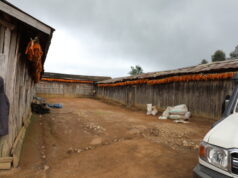
Furthermore, despite increased production levels, farmers face post-harvest challenges, including a lack of facilities to store or dry their produce, which compels them to sell their products quickly after the harvest season.
According to CCOAIB report, some of the farmers are forced to sell their produce at low prices because they do not have storage facilities to preserve their yields.
Government viewpoint and target
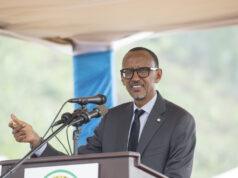
In line with the National Strategy for Transformation (NST2), Rwanda targets a 6% annual growth rate in agriculture. As mentioned before, reforms like land consolidation and input subsidies are meant to assure food security and effective usage of lands. “These measures are aimed at increasing production levels while ensuring adoption of more advanced agriculture techniques among farmers,” observed Minister of Agriculture and Animal Resources, Dr. Telesphore Ndabamenye. However, the reality on farms appears to indicate that achieving such a target will require overcoming existing systemic problems.
CCOAIB: Investing without achieving?
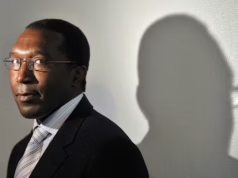
Speaking with regard to the failure to meet expectations by investing, Executive Secretary of CCOAIB, Jean Claude Ngendandumwe, points out that government investment capacity is way higher than expected agricultural output.
“It is becoming apparent that despite heavy investments, there are no significant results because of the problems including inadequate quality inputs and poor technology.” Also, the local seeds continue to fall behind compared to the imported ones.
Crossroads for an agricultural sector
According to many analysts, the country’s agricultural sector finds itself at a crucial crossroads. Although there are policies in place, their implementation needs improvement to increase their effectiveness.
Some of the important areas in which efforts need to be intensified include input delivery services, training for farmers, rural infrastructure development, and inclusive farming technology.
As Rwanda establishes itself as a case study for inclusive growth, its agriculture investments will play an important role in determining its success. According to the CCOAIB report, some farmers are forced to sell their produce at low prices due to a lack of storage facilities to preserve their yields.
Government viewpoint and target
In line with the National Strategy for Transformation (NST2), Rwanda aims for a six per cent annual growth rate in agriculture. As previously mentioned, reforms such as land consolidation and input subsidies are intended to ensure food security and effective land use.
“These measures are designed to increase production levels while promoting the adoption of more advanced agricultural techniques among farmers,” observed Dr. Telesphore Ndabamenye, Minister of Agriculture and Animal Resources.
However, the current situation on farms suggests that achieving this target will require addressing existing systemic issues.
CCOAIB: Investing without achieving?
Regarding the failure to meet expectations despite investment, Jean Claude Ngendandumwe, Executive Secretary of CCOAIB, points out that government investment capacity far exceeds anticipated agricultural output.”It is becoming apparent that, despite significant investments, there are no substantial results due to issues such as inadequate quality inputs and poor technology.” Additionally, local seeds continue to lag behind imported varieties.
Crossroads for an agricultural sector
Many analysts believe that the country’s agricultural sector is at a critical crossroads. While policies are in place, their implementation needs to be improved to enhance effectiveness. Key areas requiring intensified efforts include input delivery services, farmer training, rural infrastructure development, and inclusive farming technology.
As Rwanda establishes itself as a case study for inclusive growth, its agricultural investments will be crucial in determining its success.